

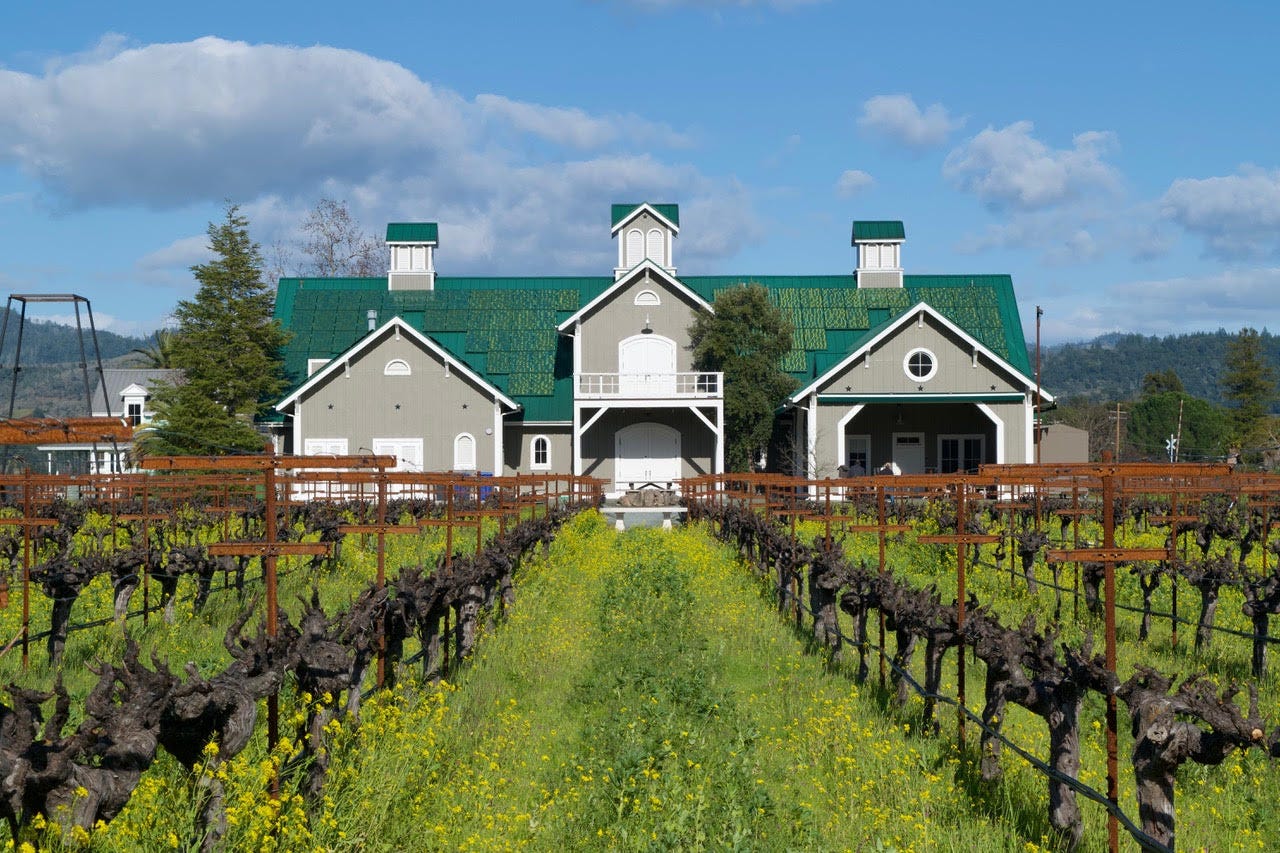
For this edition of Uncorked, I interviewed one of the most iconic winemakers in Napa Valley, and a personal favorite of mine: Cathy Corison. Cathy has been making wine in Napa since 1987, and has seen the region grow from a handful of winemakers to one of the most popular wine destinations in the world. Amongst all the high-end corporate tasting rooms along the St. Helena Highway, Corison Winery still remains a family farm. Her Cabernet Sauvignon wines are the perfect marriage of power and elegance and I’m thankful I was introduced to these early on in my wine journey. It was an honor to chat with her and I hope you all enjoy our convo below.
Mitch: Cathy thanks so much for your time today! Cork Bandit is all about celebrating wine’s place in culture, community, and memory. So let’s start with one question I ask everyone — what are one or two of your fondest wine memories?
Cathy: I prepped for this question and thought: oh my goodness, that’s hard, because I moved to the Napa Valley 50 years ago last summer, and my whole life has been tangled up in wine. I was 19 years old when I took a wine appreciation class at Pomona College on a whim. And it grabbed me by the neck and ran with me.
But there are a couple that jumped out. One was while I was still studying at UC Davis and spending the weekends back here in Napa working on the Eisele property, whose grapes went to Joseph Phelps back in the day. I’ll never forget having dinner with Milt and Barbara Eisele, and tasting a 1961 Latour. It was a legendary vintage, of course. At that point I never had a chance to taste anything that old or that fancy. And it was just a real epiphany for me. I was already in love with wine, but that was really just wow.
And then the most important memory to me was my first opportunity in wine. I had just graduated from UC Davis, and I got a job as an intern at Freemark Abbey winery in 1978. It made no sense as a career choice. Back then, Americans didn’t care what they ate and drank. There were only 30 wineries in the Napa Valley, 12 of which had opened only 3 years prior. To actually have an opportunity, as a young woman, to work in production at a famous Napa Valley winery, was a miracle.
My timing was so good. Those of us that were studying winemaking in the 70’s were on deck for the incredible growth that happened. The Judgement of Paris tasting happened one year after I got to Napa, and I feel like I’ve been hanging on for dear life ever since. It just catapulted us onto the world stage, in a way that was just kind of dumb luck, as there’s a lot of good wine made all over the world. But the Paris tasting wound up being covered in Time magazine, and it just blew up, and the rest is history.
Mitch: You mentioned to me earlier that you’re drinking a lot of Barolo right now. If you're not drinking Napa wines, what else do you like to drink?
Cathy: I taste widely and wildly. My husband has pulled a wine blind from our cellar almost every night since we were married over 30 years ago.
I should say that I cut my teeth on French wine. Especially when I took that wine appreciation class at the age of 19. At that time, in 1973, fine wine was French and that’s where I started. Chablis is a family favorite — Chardonnay doesn’t get any better than that. We drink Côte-Rôtie, Burgundy, Bordeaux. Those European wines were models for me and always informed my winemaking sensibilities. Even Riesling from the Mosel.
I’ve always wanted to make a wine that graces the table. I enjoy wines with good snappy acidity and lower alcohol. I’m looking to make wine that has a life force and a vibration.
I had a nice Barbaresco two nights ago, and last night I had a Nerello Mascalese from Sicily that was quite gorgeous.
I tend to lean toward more traditional wines stylistically. You know, fashion comes and fashion goes in winemaking. But the wines I love, they grace the table, they have a life force, and they’re powerful and elegant.
Mitch: That’s an amazing tradition you guys have. So almost every night you’re pulling something blind?
Cathy: Yes absolutely.
Mitch: How’d you get into Mosel Riesling? That’s a personal favorite of mine too.
Cathy: When I first got to the Napa Valley, there was Riesling everywhere here. It’s hard to believe, but I made Riesling for 10 years at Chappellet during the 1980s. And lots of people made Riesling, but now there’s very little left.
I have always loved the wines of Germany, especially Mosel. I can’t tell you for sure when I had my first one, but it’s one of my very favorite things in the whole world.
I’m making a little bit of Riesling now. It’s on a home-winemaking scale, kind of a fun side project. It’s about 100 cases and it comes from Wirz Vineyard in Cienega Valley. So not Napa Valley. We can make Cabernet Sauvignon as well or better than anybody in the world here, but conditions tend to be a bit warm for Riesling on the average.
The Cienega Valley is at about 1500 feet of altitude, located near Calera. Josh Jensen went looking for limestone soils and found them there, though there’s very little limestone in California. It’s a very singular place. The vines are over 70 years old, growing on their own roots and dry-farmed!
I’m on my 4th or 5th vintage of Riesling, just goofing around. It never leaves the winery much. We’ve sent some to our club members, and pour it at the tasting room. There are a few restaurants that are top supporters of our Cabernet that have it as well.
Mitch: Is there a wine region you think deserves more attention?
Cathy: Probably Macedonia in Northern Greece. They make beautiful wines from the Xinomavro grape that are very Nebbiolo-like. I talked to somebody that knew of genetic studies and it turns out they’re not related, but in a way I’ve still been waiting all these years to find out that they were somehow the same variety. Beautiful, beautiful wines made from Xinomavro, and very moderately priced.
My husband is, as of a couple months ago, a Greek citizen. His mother was born in Greece, so after many, many years, he was able to become a citizen.
Mitch: How’s it been working with your daughters in the winery?
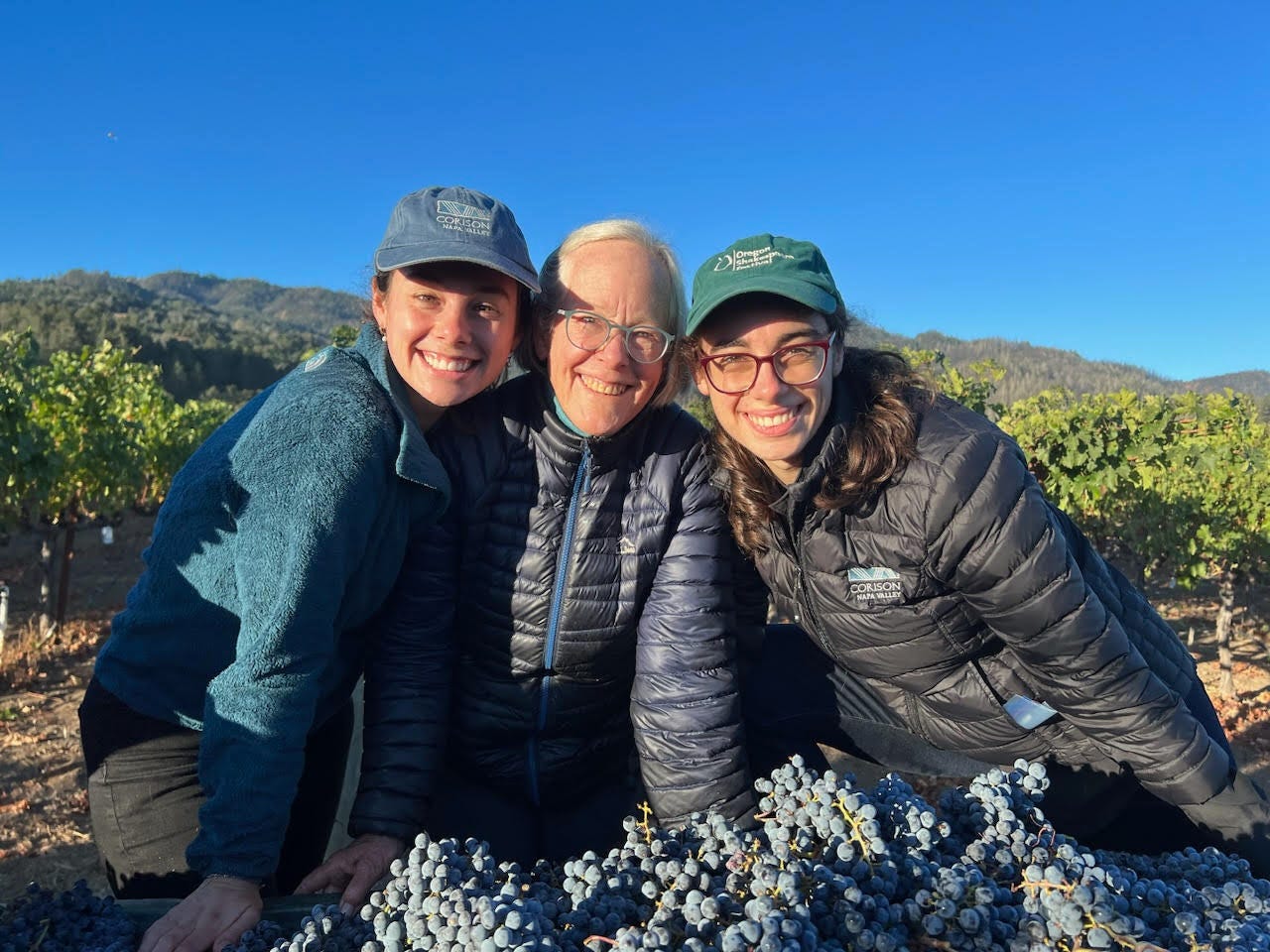
Cathy: It’s such a miracle, and I’m so grateful that one of my daughters, Grace, has worked her way into being my assistant winemaker. She’s been full-time for 5 years, and it’s such a relief to know we’re not going to be owned by a private equity firm or some enormous corporation.
Mitch: Yeah, it’s got to be pretty neat knowing the legacy will be carried on by your family.
Cathy: Yes, and we work together really well. We just did blending trials this morning. We didn’t always know that my kids would come back to the winery, so it is such a relief.
Mitch: How’s it been getting your daughter Grace up-to-speed in terms of her palate, blending and tasting the wines, etc. I don’t know how much of it is science, how much is art? I’m sure it’s a little bit of both.
Cathy: It’s both of course. And then there’s individual variability too — people have different strengths. Both my kids have been drinking a little wine with dinner since they could sit up in a chair. We did the European/Italian method of one finger of wine plus four fingers of water with dinner. At some point, when Rose was in middle school, she piped up and said “Mom, can I just have the wine?” So she would have one finger of wine without the water, roughly a sip.
Now that they’re in the business, they already have really good palates and similar sensibilities to ours, because they’ve been enjoying and learning about wine with us for decades.
Mitch: So these days, with climate change and declining alcohol consumption, so often the outlook on the wine industry is negative. Personally I’m an optimist and just want to ask — what are you most excited about when it comes to the future of wine?
Cathy: Well, I love the fact that truly great wine is being made all over the world. I think it always has been to some extent, but I think it’s even more true now. So for wine lovers, it’s a magical time.
Mitch: With how the climate is changing in California, do you think you’ll see different varieties planted? Or will the demand for Cabernet always trump that?
Cathy: People with more space and more money are already playing with other varieties, and I’m watching with interest. I think in my lifetime, that’s not going to be an issue, but maybe it will be for my kids?
When it comes to climate change, what we’re seeing as much as warming is erratic conditions. I’ve seen, in the last 15 years, both the coldest season ever recorded in the Napa Valley, and the 2 warmest seasons ever recorded in the Napa Valley.
But, thanks to the ongoing marine influence all summer and fall, we have not reached a point where we can’t make some of the best Cabernet Sauvignon in the world. We just have to adapt and be nimble.
Mitch: It seems like you’ve been able to manage alcohol levels pretty well.
Cathy: Completely. There’s scarcely a single vintage that’s been 14% or higher. The 2017 was 14.1%. A lot of people blame the big Napa style on global warming, but that’s really not what’s going on. That’s fashion. Fashion comes and fashion goes in wine.
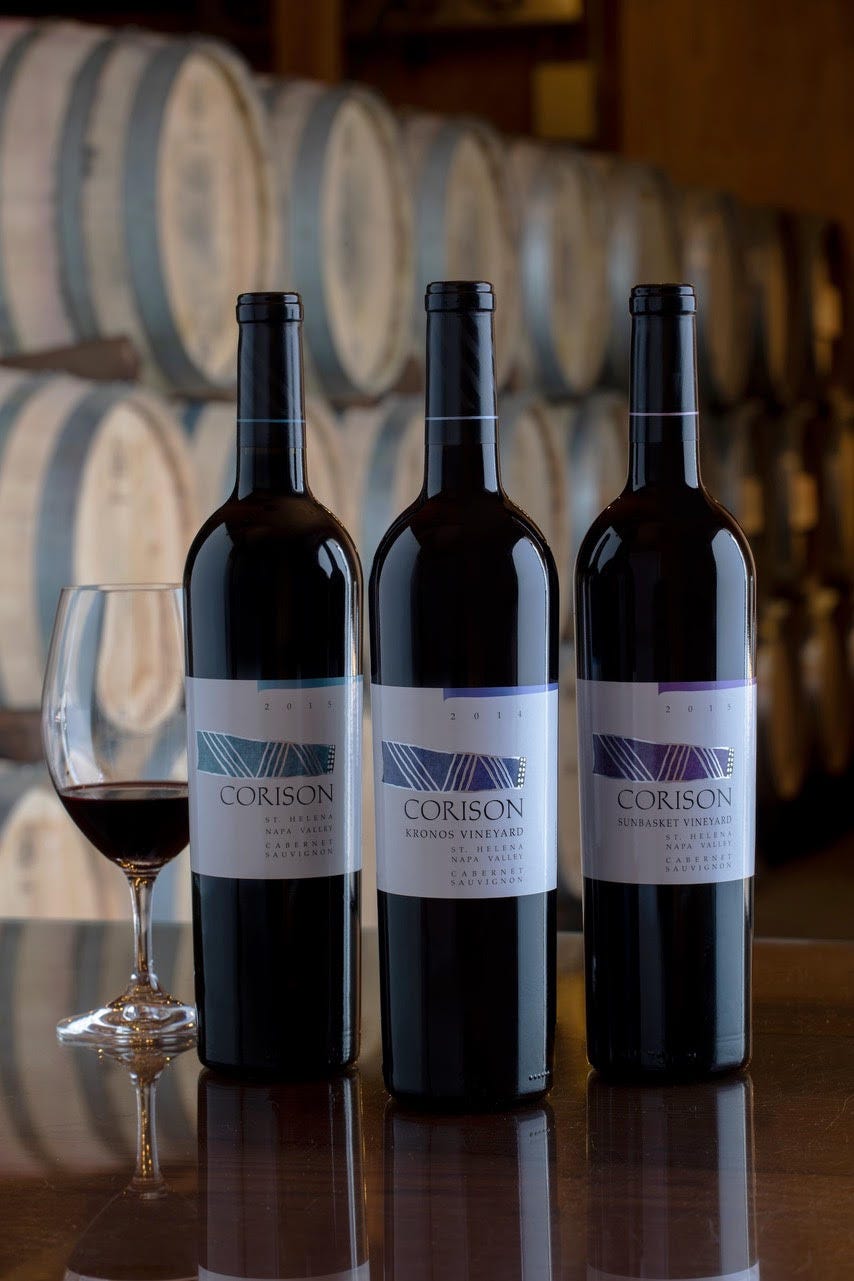
Mitch: You produce two single vineyard wines — Kronos and Sunbasket. How would you describe the difference between those two?
Cathy: The differences are amazing. I know you’ve been here to see them. Kronos vineyard surrounds the winery. It’s on classic alluvial gravelly loam — what we call benchland. The soils are just perfect for grapes in general, but Cabernet specifically. They hold water when the vines need it, and then because we have rainless summers, the vines run out of water and stop growing right around veraison, which is exactly when they need to stop growing and start ripening the fruit.
We have enough heat to reliably get Cabernet Sauvignon ripe, but we have very cold nights because the fog comes in every night from the San Francisco Bay. We enjoy one of the biggest diurnal shifts anywhere in the world. And that’s the key for Cabernet. Cabernet is a late variety, and takes a lot of heat to get ripe. But to make truly great Cabernet, you’ve got to have cold nights to preserve natural acidity, and to develop inky color and complex flavors.
The Sunbasket vineyard soils are really quite similar, but have even more gravel than Kronos. Most everything else is different, including age, rootstock, scion clone, training, and row direction. I’ve made wine from that vineyard for over 35 years through 3 different owners. And then we had the amazing good fortune to purchase it. Another miracle in a whole series of miracles for me. It had always been one of my favorite vineyards.
It’s quite close to Kronos— I can see it from the balcony here at the winery. But the wines are so different. They’re much more red fruit driven, where the Kronos leans more into the purple and black fruit direction and is more brooding. That’s partly because Kronos has truly old vines. They’re 55 years old this year.
You can almost throw a rock between the two vineyards, but they make completely different wines.
Mitch: That’s such a cool thing about wine.
Mitch: I’ve always wanted to ask — what’s the significance of your logo? The ribbon?
Cathy: I talked about wanting these wines to have a life force. I’m a biologist and I believe wine is alive. So those are 7000 year old life symbols. They were found on pots in what is today the Middle East, in the birthplace of Vitis Vinifera (the species of grapevine that produces almost all the wines of the world).
Archaeologists know they made wine in those pots because they found tartrate crystals. Isn’t that cool? The ribbon on my label is a life symbol based on rain, and the symbol at the top of the capsule is a life symbol based on a sprouting seed.
Mitch: When you’re not working, what do you like to do?
Cathy: Hike, cross-country ski. Lots of theater.
Mitch: What kind of music do you like?
Cathy: Well, we’re extremely lucky here. John Kongsgaard, a very famous winemaker in Napa, is very involved in the classical music world. He’s an impresario and has run a chamber music festival down in Napa for decades now. He brings in world class people. So that’s probably my biggest exposure to music.
Mitch: Do you have any wine and food pairings you’ve been going to recently? Anything that’s maybe a bit unorthodox?
Cathy: I have a newfound love of caviar, potato chips, and champagne. I’m not as fussy about wine pairings as maybe some people are. It’s wonderful when they happen, but it’s not something I spend too much energy on.
Mitch: When you have a great bottle, sometimes the wine is the main event, not the food.
Cathy: Yeah, you know, great chefs don’t want that in their restaurant, but winemakers are happy when that happens.
Mitch: What role do you see wine play in the world?
Cathy: One of the things that’s so interesting about wine is that it plugs right into our emotional brain. And that’s physiological. That’s biology. That’s one of the reasons it’s so evocative. How many times have you put your nose in a glass and it just transports you to somewhere else? It’s magic.
And wine is meant to be shared. If you don’t share it, it’s in a vacuum, it’s in a void. Wine’s not meant to be like that. Humans have been sharing wine for millennia.
Very interesting article Mitch. Thanks for posting!