

Hey wine friends. Welcome to another edition of my Uncorked series — quick-hit interviews with elite winemakers.
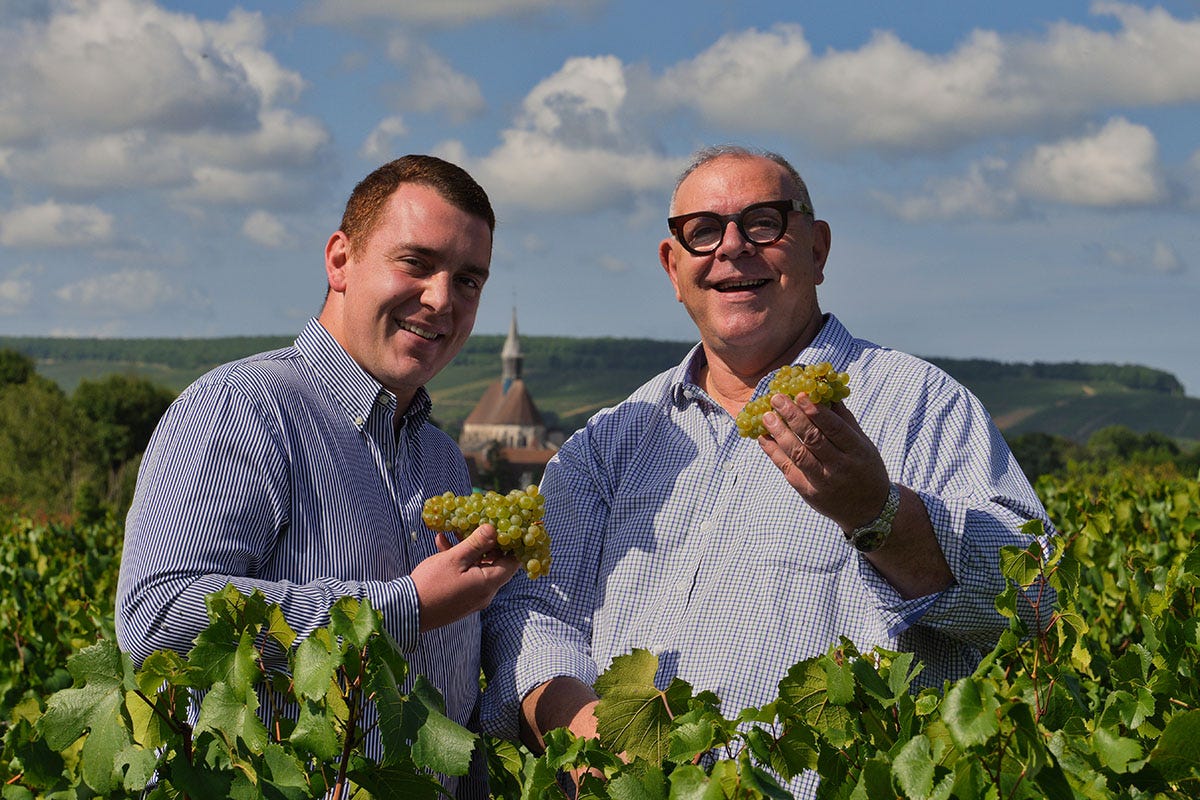
Today I’m featuring one of my favorite Chablis producers: Defaix. This family has one of the longest documented histories in Chablis, tracing their viticulture roots back over 400 years!! Daniel-Etienne Defaix, and now his son Paul-Etienne, are known for releasing their wines only after extended aging — sometimes 15 years later than the rest of the region. They’re awesome wines — mature and textural Chardonnay. For us wine geeks, I think few things are more exciting than wines that stand as pure expressions of place. Defaix practices organic farming, natural fermentations, stainless steel aging, yada yada… all the stuff you’d expect from a winemaker that prioritizes terroir.
Paul and I have a bit of a language barrier between us, so we communicated back and forth over email for this one.
What are one or two of your fondest wine memories? Who were you with, where were you, what were you drinking, etc.?
My best memories are undoubtedly those years working with my father (Daniel-Etienne Defaix). Years spent by his side in the vineyard and the cellar, learning, listening, and respecting him. Today, my favorite moment with him is when every vintage, for two days straight, we taste all our tanks and share our opinions on our wines.
A specific memory I have — Christmas 2020, I held a blind tasting of a magnum of 1970 Meursault from our family cellar. Everyone was incredibly surprised by the beauty of this wine, still so fresh, with lovely acidity, notes of toast, superb development without being oxidized.
My father started to shed a tear, and then told me with certainty, "It's a 1970 Meursault from J. Sourdillat." No one understood how he had perfectly identified the wine or why he was emotional… then he explained: "Mr. Sourdillat was a winemaker I knew, who had vineyards all over Burgundy, Chablis, Meursault, Chassagne, etc… these were the some of the first vineyards I ever purchased when I was 20 years old." I was really happy to taste a memorable bottle, and to share this moment with my father who was very moved.What are some wines that were most influential to your wine journey?
First and foremost, of course, my father’s wines, his definition of great Chablis. Second, the wines of the Côte de Nuits/Côte de Beaune, the distinguished elegance of Pinot Noir and Chardonnay from great terroir. Third, the Syrah from Côte-Rôtie. They are simply incredible wines that combine power and finesse.
Your family chooses to delay the release of your wines until many years after harvest, allowing the wines to obtain significant bottle age before they reach the consumer. Many in wine don’t do this — it’s not exactly financially beneficial. Can you tell us why this is important to your philosophy?
Our wines age in stainless steel tanks for 10 years on the fine lees, because we want wines that are both ready to drink upon release, but will also age beautifully even further. The lees add structure, aromatic complexity, and a softened acidity. My father adopted this philosophy and passed it on to me, because we love wines that have aged, that develop their flavors, and that gain depth and complexity.
A Cistercian monk once said: "Only great wines are those that know how to age."You produce wine from some very, very old vines. I think I read some are over 100 years old? Can you tell us more about that, and the effect it has on the quality of the wine?
Yes, some of our vines were planted in 1900 by my great-grandfather. They are ungrafted, allowing us to practice massal selection (read about that here). Our vines are not grafted from clones, which allows us to preserve the unique genetic heritage of each vine.
The average age of our vines is 60 years, some planted by my great-grandfather, some by my grandfather, and some by my father. Yields are lower with old vines, but the quality is significantly higher. Ripening is optimal, and the juice is much more aromatic, with a crystalline purity very typical of great Chablis.Do you and your father ever differ in opinion when it comes to the wines?
To be perfectly honest, no, because he taught me everything. So I'm inevitably shaped like him.Do you have any favorite wine and food pairings?
Nothing original — I enjoy the classics, like 10-year old Chablis with a seafood platter or some of the best French cheeses. For me, the magic of Defaix Chablis is in its age. We recently opened a 1995 Chablis Premier Cru Côte de Léchet, which we paired with a Bresse chicken in a cream and truffle sauce. I can tell you it was absolutely incredible.If you weren’t making wine in Chablis, is there anywhere else would you like to make wine?
Not an easy question when our heart and roots are in the Kimmeridgian of Chablis… I think I would like to produce Riesling in Germany.What’s a wine region you think deserves more attention?
Beaujolais deserves a lot of attention; you can find incredible and totally different wines depending on the crus, the terroirs, the winemakers… A region that is too underrated for me, but which deserves to flirt with the wines of Burgundy.This Substack is all about how wine connects with culture. What role do you see wine play in culture?
Wine has always been a powerful social bond between people; it brings them together, it tells stories (about its origin, its cultivation methods, etc.). It sparks questions, it awakens our curiosity, and it inspires us to learn more. Looking back, Bacchus, Dionysus, and Jesus Christ — they all shaped the history of wine. All these factors make wine an integral part of culture, just like art and classical music. It’s a form of cultural expression that transcends time.What kind of music do you like? Any “desert island” albums?
My favorite style of music is jazz. For the rest of my life I could listen to the albums of a French artist named “St Germain.” His album Tourist is simply incredible.So often the outlook on the wine industry is negative — what are you most excited about when it comes to the future of wine?
Wine will always have its place; it’s a way of life, a culture, our history. We can’t forget thousands of years of history! The current global context may not be conducive to the commercialization of wine, but people love to drink and they haven’t forgotten these values. I haven’t lost hope!
Hope this inspires you all to drink some Defaix. The 2014 vintage — Paul’s first vintage as winemaker — was just released last year. Imagine that: he was making wine for over a decade before he saw even one of his bottles hit the market. Even though I understand it’s not ideal for business, as a consumer I really appreciate being able to purchase a ready-to-consume product. I don’t love the idea of buying something I can’t drink for decades (I’m looking at you Barolo…)
Admittedly I don’t know much jazz, but I’m listening to St. Germain as I type this up and I will definitely work this into my rotation. I actually featured Defaix in one of my Cork Beats music pairings last year. It was the week Brian Wilson passed, and I thought the textural, layered maturity of the wine paired well with the some of the greatest layered harmonies of all time — those of the Pet Sounds record. But next time I open some Defaix I’ll put on some French jazz. Thanks Paul :)