

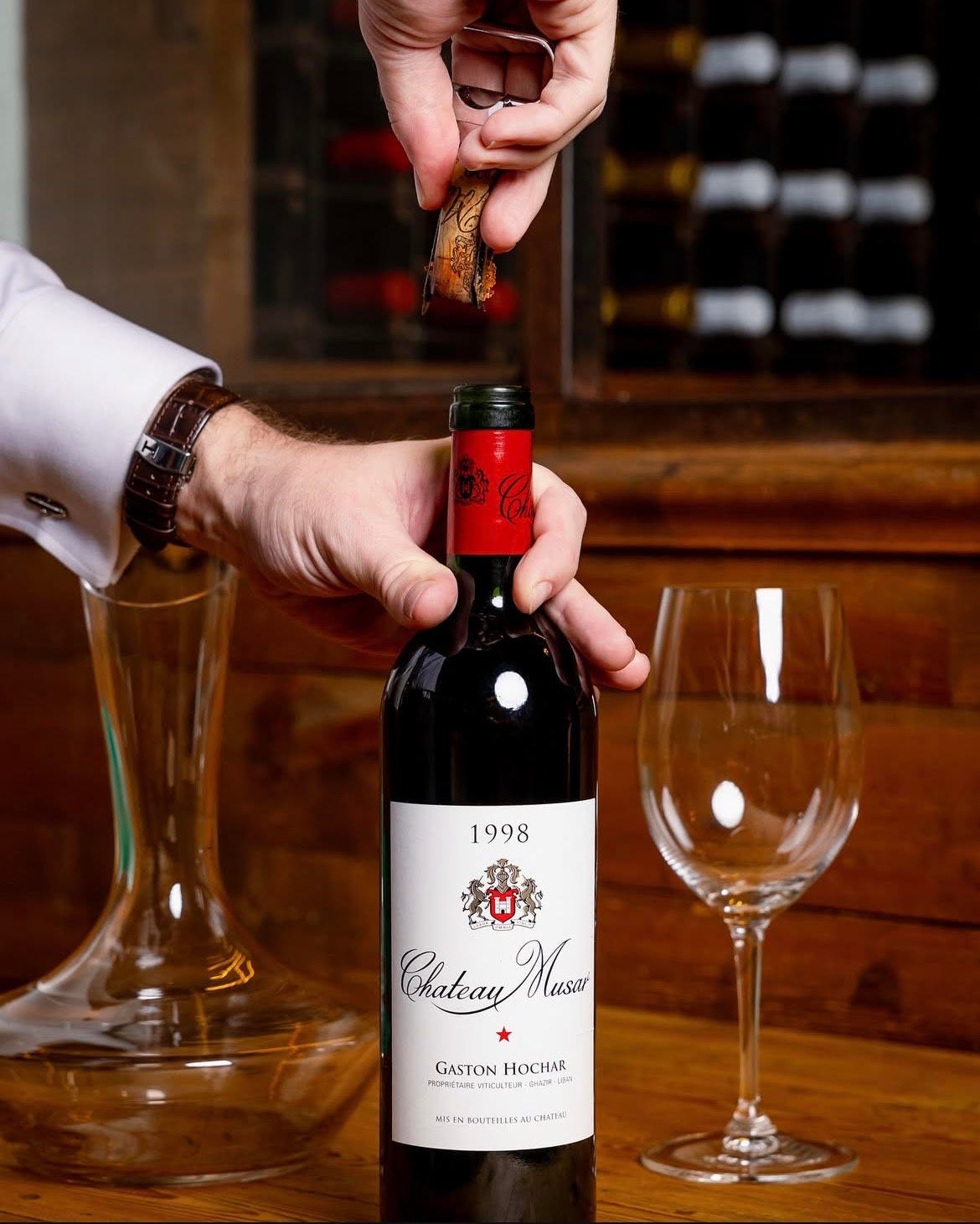
Welcome to the first edition of my new series Uncorked: quick-fire interviews with elite winemakers, industry pros, and fellow wine enthusiasts. To kick this off, I had a conversation with Marc Hochar, co-owner of Chateau Musar, the most iconic winery in Lebanon and a “cult” favorite of many collectors (myself included).
I really enjoyed my convo with Marc and typing this up has got me pumped for this new series. Enjoy!
What are one or two of your fondest wine memories?
I’ll give you two — one Musar and one non-Musar memory.
I attended a tasting in Germany with a big collector. He poured 18 different bottles, all rare high quality wines. One of them stood out amongst the rest — a 1961 L’Arrosée. This wine made me totally rethink Bordeaux. It was so elegant — completely different from what I had understood Bordeaux to be. Up to this point I only had experience with Bordeaux going back to the 80’s, but never older. It was a special moment to drink a mature wine from such a legendary vintage.
On another occasion, our importer Broadbent poured us a blind tasting of several wines. One I immediately recognized as Musar, and the question was just down to which vintage it was. I guessed early 90’s as it was showing less fruit, more earth, and more maturity. However, it was revealed to be much younger — the 2001 vintage. This was a lesson learned for me: it’s very difficult to put Musar in a vertical. Musar is always roughly one third each of Cabernet Sauvignon, Carignan, and Cinsault. One variety might ripen more than the other and dominate the blend more. Certain vintages may show “grey hair” faster than others. This was a key learning experience for me for our own wines.
Are there any other wines that have been influential in your wine journey?
1983 Musar. When I first started drinking wine in my early 20’s, this was the vintage that really got me into wine. We were forced to harvest later than usual in ‘83 due to the Lebanon War. So the wines were riper, but beautiful. The weather was really quite amazing. It would maybe be a little too ripe for my palate today, but I still have fond memories of it as it came to me at the junction of me beginning my wine journey.
I attended a dinner with you last year, and one thing that stuck with me was you saying you like to “hide your cab”. Can you expand on that for my readers?
For us, the Cabernet is the backbone or “skeleton” of the wine. It gives structure, but in its youth, it’s not as approachable or drinkable. We also want our wine to move away from fruit as it ages — instead developing aromas that are earthy, animal, mature, etc. These we get from the Cinsault and the Carignan. We don’t need a bold masculine wine. We prefer something more elegant and subtle. So we “wrap” the other 2 varieties around the Cabernet.
A generous friend of mine opened my birth-year vintage (1994) Musar for my birthday last February. It was one of the best wines I drank this year. I’m just curious what you think about that vintage?
I have a good story for this. Upon release, we poured some for a distributor in Chicago, who absolutely loved it. In fact, he loved it so much he purchased every single bottle we had made available. Fast forward a year or two, and sometimes, our wines can go through what I call an “adolescence” phase — and maybe the wine shuts down for a period of time. It can be a necessary step in the aging process. However, the distributor came back to us and asked for a refund as he wasn’t quite pleased with how the wine was showing. After some back and forth we agreed to take the bottles back.
Roughly 20 years later, sometime around 2015, we did a tasting in Chicago of some back vintages, including 1994. Some guy absolutely loves it and asks to buy as much as possible. Funny enough, he is with the same distributor who returned the bottles 20 years ago. And yes, we sold them some, but at a much higher price and much lower quantity.
That’s like selling Apple stock in 2009 and buying it back today… yikes.
Do you have any favorite unorthodox wine/food pairings?
If you take old white Musar, like 30, 40, or even 50 years old, and the nose is all honey, wax, honeydew, but the palate is totally dry — it is an amazing pairing with foie gras. The nose connects with the sweetness of foie gras, but with the palate of Musar Blanc being so dry and saline, it breaks it up much like when you see people eat chunks of salt with their foie gras. I love it.
So often the outlook on the wine industry is negative. What are you most excited about when it comes to the future of wine?
People are moving away from pure Cabernet and Chardonnay, and there is a lot of interest in new regions and new varieties that are not copy/paste from one bottle to the other. There is an evolution in the market to wines that are real and genuine.
If you weren’t making wine in Lebanon, where else would you like to make wine?
I’m thinking about quality of life here. I love the sun and I love Sangiovese, so probably Tuscany.
On this you and I agree! We can be neighbors. What’s a wine region you think deserves more attention?
I’ve really enjoyed Nerello Mascalese from Mt. Etna, Sicily. It has a life to it. Great terroir, organic farming practices… they’re not overdoing it. They know exactly which grape varieties work best with their land, since they’ve been doing it for centuries.
Speaking of indigenous grape varieties, tell me about Musar Blanc, your white wine.
Yes, it is similar to how our local white varieties, Obaideh and Merwah, are so well-adjusted to our terroir. These grape varieties have been in Lebanon for thousands of years. We actually harvest the whites after the reds, which is not typical for most wine regions, and still only end up somewhere around 12% alcohol.
I’ve also made this into somewhat of a music blog, and usually feature wine and music pairings in my newsletter. So, what type of music do you enjoy?
Dance music, but not full techno. Good DJ’s that keep the beat going. Like David Guetta. I don’t think this pairs very well with Musar though…
This Substack is a place to celebrate wine and the ways it enhances our culture. How do you see wine’s place in culture?
Ultimately what wine does is it brings people together. When you taste wines with groups of friends, it’s a very inclusive environment. You share wines from different cultures all over the world, and you appreciate the terroir, the land, the traditions. Wine is not just something to drink — it elevates the conservation. It’s about inclusion and it’s about embracing culture.
Marc — thanks so much for your time. Your wines have been a special part of my own wine journey, and I hope this encourages everyone to go drink some more Musar. Cheers.
Such a great read. Stoked for more of this series! Craving some Musar now...